
Vaccine refrigerator monitoring for clinics: meeting CDC storage and logging requirements
Vaccine refrigerator temperature monitoring: a practical guide to CDC compliance and preventing vaccine loss
Vaccines are among the most temperature-sensitive products a healthcare facility handles. A refrigerator that drifts a few degrees overnight can quietly ruin an entire inventory, and staff may not find out until a patient is already in the chair. Vaccine refrigerator temperature monitoring exists to close that gap—to catch problems while there's still time to act, and to prove to auditors that your cold chain held.
This guide connects the CDC's storage requirements to the real operational problems clinics face: excursions that happen after hours, doors left open during stocking, and audit logs that don't hold up. It also explains how wireless, continuous monitoring solves those problems in ways manual logging cannot.
Why vaccine refrigerator temperature monitoring matters
The financial exposure is significant. A single storage unit can hold tens of thousands of dollars in vaccines, and a compressor failure or a door left ajar overnight can spoil all of it at once. When that happens, the loss is rarely covered, and reordering takes time you may not have.
The greater risk is to patients. Vaccines that spend too long outside their safe range can lose potency without any visible sign of damage. Administering a compromised dose means a patient may not be protected, and often no one knows until an outbreak or a titer test reveals it.
Compliance obligations raise the stakes further. Facilities enrolled in the Vaccines for Children (VFC) program and other publicly funded initiatives are required to monitor and document storage temperatures. Failure to do so can jeopardize program eligibility and the free vaccine supply that many clinics depend on.
Finally, monitoring protects your reputation. A well-documented cold chain reassures patients, partners, and inspectors that your clinic takes safety seriously—and one publicized spoilage event can undo years of trust.
What temperature range vaccine refrigerators must maintain
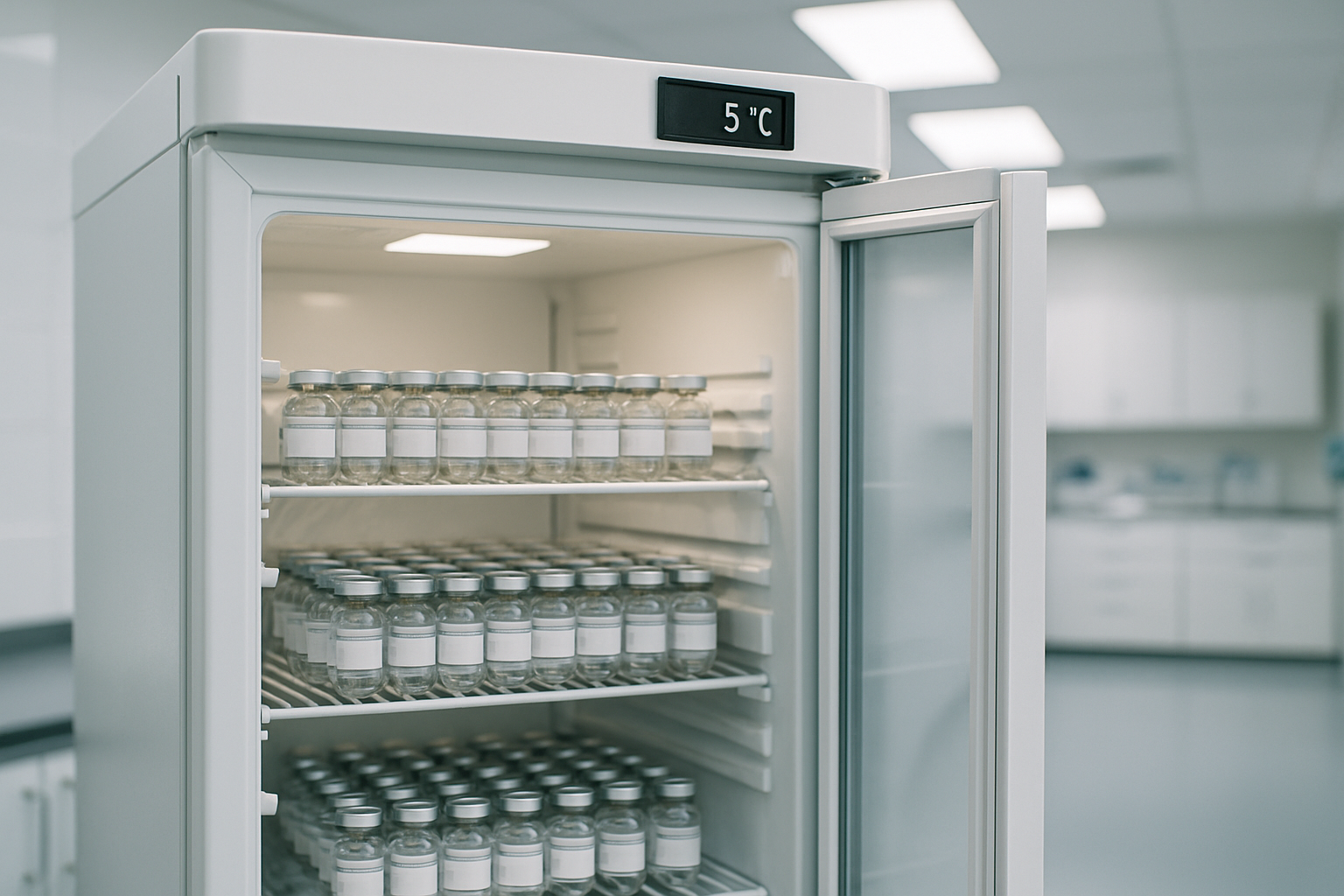
Refrigerated vaccines must be kept between 2°C and 8°C (36°F to 46°F), with 5°C (40°F) as the target midpoint. Aiming for the middle of the range gives you a buffer against short swings in either direction, so a brief door opening or a defrost cycle is less likely to push a unit out of bounds.
Frozen vaccines require a much colder range, typically -50°C to -15°C (-58°F to +5°F). These products are handled in dedicated freezers, never in the freezer compartment of a combination household unit.
Potency is the reason these numbers are strict. Even brief excursions can degrade certain vaccines, and repeated small excursions add up over time. Because damage often isn't visible, the temperature record is the only reliable evidence that a dose is still viable.
Placement inside the unit matters too. Vaccines should be stored in the center, away from walls, vents, and the floor of the compartment, where temperatures fluctuate most. Stable placement and adequate airflow keep readings consistent with what your sensor reports.
What CDC guidelines recommend for monitoring vaccine storage
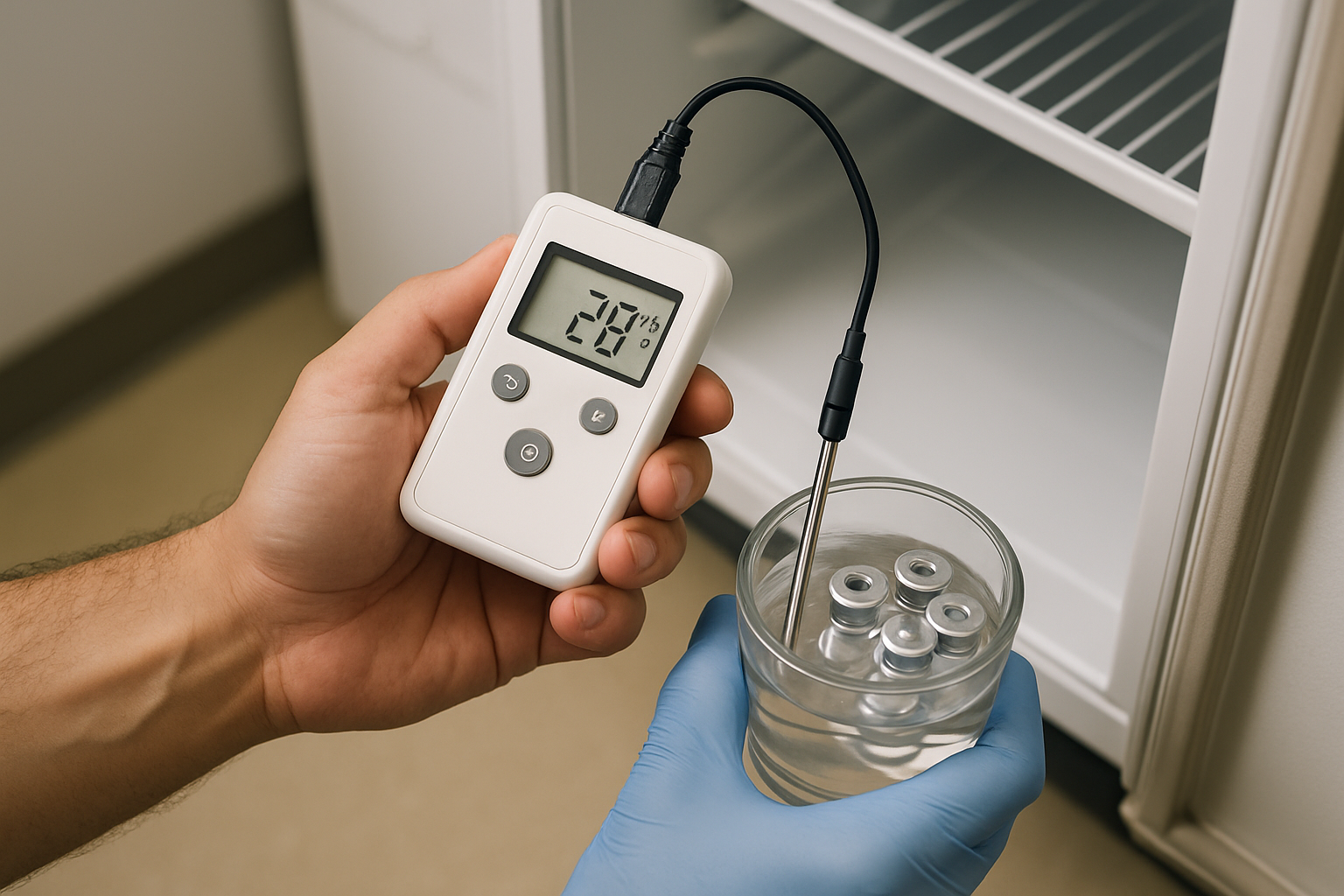
CDC guidance centers on using a digital data logger (DDL) with a buffered temperature probe. The buffer—usually a probe suspended in glycol, glass beads, or a similar medium—mimics the temperature of the vaccine itself rather than the air, which changes rapidly every time the door opens. This gives a more accurate picture of what your product is actually experiencing.
The guidance calls for continuous recording, with minimum and maximum readings reviewed and documented at least twice daily. Staff are expected to check the current temperature and the recorded high and low, then log the results.
Data loggers must undergo calibration testing, with a certificate of calibration (or a report of calibration) on file. Recalibration is typically recommended on a set schedule, often every one to two years depending on the device.
CDC also expects records to be retained for audits, commonly for three years or longer depending on state and program rules, with recording intervals frequent enough to reconstruct what happened during any excursion.
Here's the practical point: twice-daily manual checks satisfy the minimum, but they leave hours of unmonitored time between rounds. Continuous automated monitoring exceeds the requirement—it records around the clock and alerts you the moment something goes wrong, instead of relying on someone happening to be present.
How wireless temperature monitoring works
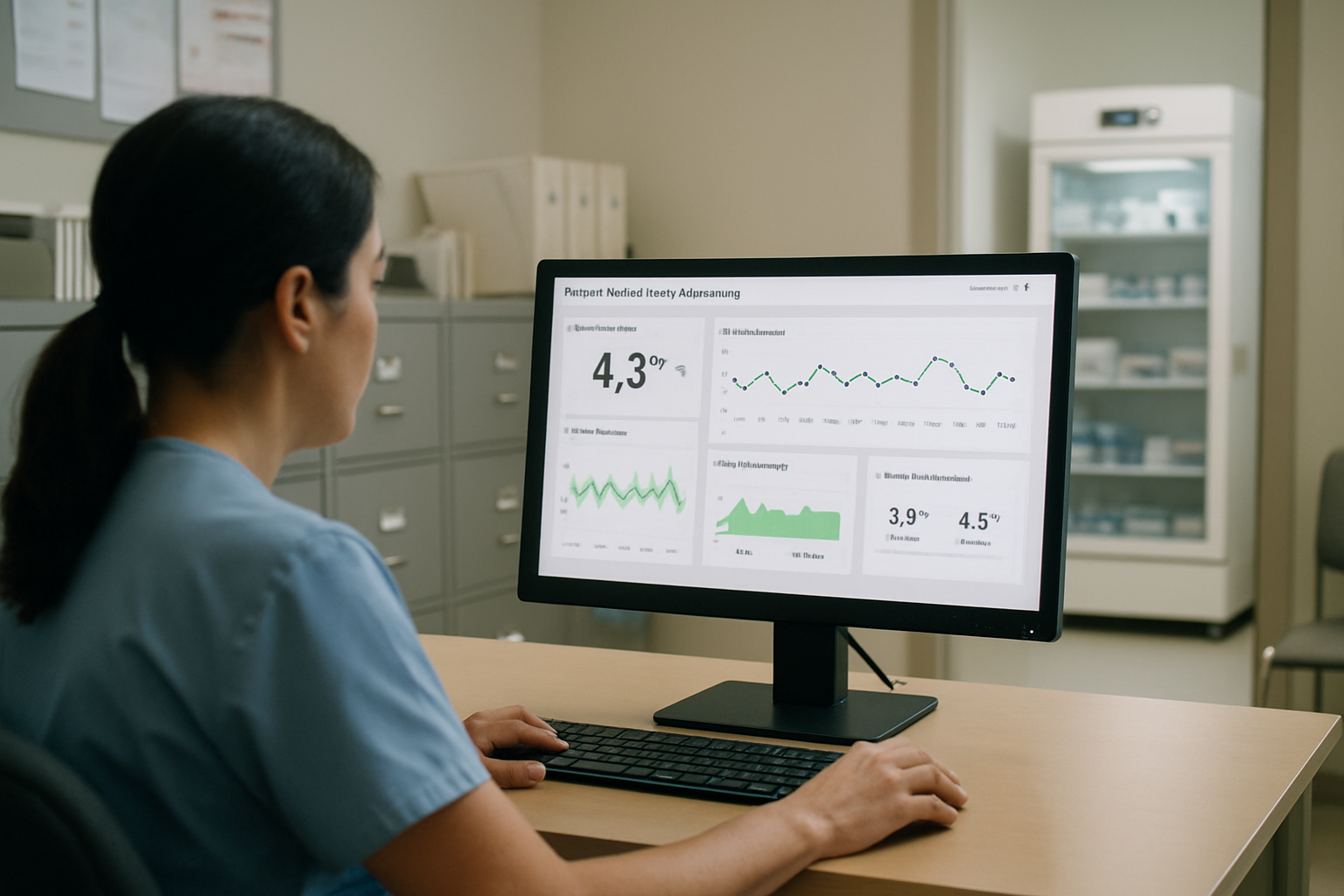
A wireless monitoring system places a sensor and buffered probe inside the storage unit. The sensor transmits readings out through the door gasket or via low-power radio signals, so there's no need to drill holes in the cabinet or run cables that break the seal. That keeps the unit intact and the installation simple.
Readings are captured at regular intervals—every 20 minutes, for example—and sent to a central dashboard you can view from any browser. Because the data lives in the cloud, a facility manager can check every refrigerator across multiple sites without walking the floor.
Battery life is a quiet but important detail. A sensor with a 10-year, user-replaceable battery means fewer maintenance visits and no coverage gaps caused by a dead device that no one noticed. When the battery finally does need changing, staff can swap it without a service call.
Compared with manual logging, the advantages are concrete: no missed readings when the clinic is closed, no transcription errors, and a complete timestamped history that's always ready to review. Many of the same principles apply to any cold storage; our guide to refrigerator temperature monitoring covers what to track and how often in more general terms.
Manual logging versus continuous automated monitoring
Manual logging has structural weaknesses. The gaps between the morning and evening checks—overnight, over lunch, across a weekend—are exactly when excursions go undetected. A unit can fail Friday evening and not be discovered until Monday.
Handwritten logs are also error-prone. Numbers get transposed, entries get skipped, and in the worst cases logs are backfilled from memory, which auditors are trained to spot. None of this reflects poorly on staff; it reflects the limits of a manual process.
Automated systems produce a complete, timestamped record with no gaps and no human handwriting to interpret. And because the twice-daily rounds are no longer the only line of defense, staff reclaim time for patient care while the system watches continuously.
Common causes of temperature excursions and how monitoring catches them
Most excursions trace back to a handful of causes:
- Equipment failure — a failing compressor, a drifting thermostat, or an unplugged unit.
- Doors left open too long during stocking or inventory counts.
- Overcrowding that blocks internal vents and disrupts airflow.
- Vaccines placed too close to cooling elements, causing localized freezing.
- Power outages and defrost cycles that briefly push temperatures up.
The value of 20-minute interval data is that it reveals not just that an excursion happened, but its shape. A slow, steady climb over hours points to a dying compressor. A sharp spike that recovers quickly points to a door left open. That pattern is the difference between guessing and knowing, and it tells you whether to call a technician or coach a team member. The same logic helps with placement decisions—our article on where to place a wireless sensor in a walk-in cooler explains how sensor location affects the readings you get.
Preventing vaccine loss during nights, weekends, and holidays
The hardest excursions to catch are the ones that happen when no one is in the building. A refrigerator doesn't keep business hours, and a holiday weekend can turn a minor fault into a total loss.
Automated alerts solve this. When a reading crosses your threshold, the system sends a text, email, or phone call to the responsible person immediately—not at the next scheduled check. That person can often fix the problem remotely-adjacent (dispatching someone, calling maintenance) before product is lost.
Good systems also support escalation. If the first contact doesn't acknowledge the alert within a set window, it moves to a backup contact, and then another. This ensures a sleeping phone doesn't cost you an inventory.
Response time is everything. Vaccines can tolerate a brief excursion; what ruins them is prolonged exposure. Cutting the discovery time from "Monday morning" to "within minutes" is often the line between saving and discarding thousands of dollars of product. Every after-hours event is also automatically logged, giving you clean documentation of what happened and how you responded. If you're weighing standalone alarms, our guide to freezer temperature alarms breaks down how they work.
Spotting personnel issues, not just equipment failures
Continuous data does more than flag broken hardware. It reveals human patterns.
A gradual decline in performance usually means equipment—wear on a compressor, a seal losing its grip. A sudden, sharp spike that recovers on its own usually means a door left open, often during stocking. The temperature curve tells you which is which.
Over time, trends become visible. If spikes cluster around the same shift or the same weekly delivery, you've likely found a stocking routine that keeps the door open too long. That's not a maintenance issue; it's a training opportunity.
Used well, this data supports coaching, not blame. Showing a team the pattern—"the fridge warms every Tuesday morning during restock"—turns an abstract rule into a concrete, fixable behavior and drives real process improvement.
Features to look for in a vaccine temperature monitoring system
When evaluating a system, prioritize:
- Wireless installation with no drilling, so the unit stays sealed and intact.
- A calibrated, buffered probe suited to vaccine storage, with a calibration certificate.
- Configurable alert thresholds and multiple notification channels (text, email, phone).
- Long, user-replaceable battery life—a 10-year battery minimizes gaps and maintenance.
- A cloud dashboard with secure remote access to every unit.
- Humidity monitoring where your storage environment calls for it.
- Scalability across multiple refrigerators, freezers, and locations from one account.
Supporting audit-ready records and compliance documentation
Automated monitoring turns compliance documentation from a chore into a byproduct. Every reading is stored securely with a timestamp, building a continuous log without anyone lifting a pen.
When an inspector or VFC coordinator asks for records, you can produce exportable reports covering any date range in seconds. The history includes every excursion, its duration, and the corrective action taken—exactly what auditors want to see.
Because the data is captured automatically, there's no risk of missing entries or logs that appear falsified. Continuous, machine-generated records simplify inspections and demonstrate that your cold chain was monitored around the clock, not just twice a day.
Getting started with wireless monitoring for your clinic
Start by assessing your units: count your refrigerators and freezers, note their storage volume, and identify risk points—an aging unit, a fridge near a busy stocking area, a location that's unstaffed overnight.
Next, set alert thresholds aligned with CDC ranges, building in a small buffer so you're warned before product is actually at risk rather than after.
Assign clear responsibility. Decide who receives alerts, who backs them up, and what the response protocol is for both business hours and after hours.
Finally, train staff to respond to alerts and to review the dashboard periodically. The technology handles the watching; your team handles the acting. Together they protect both your inventory and your compliance standing.
What temperature should a vaccine refrigerator be kept at?
Refrigerated vaccines should be stored between 2°C and 8°C (36°F to 46°F), with 5°C (40°F) as the target midpoint. Aiming for the middle of the range provides a buffer against brief swings.
How often does the CDC require vaccine storage temperatures to be checked?
CDC guidance calls for continuous recording with a digital data logger, plus review and documentation of the minimum and maximum readings at least twice each workday. Continuous automated monitoring exceeds this by recording around the clock and alerting staff to problems immediately.
Can wireless monitoring replace manual temperature logs for compliance?
A calibrated wireless system with a buffered probe and continuous recording meets and exceeds the data-logging requirements, and its automatic timestamped records are ideal for audits. Confirm your specific program and state rules, but continuous monitoring generally provides stronger documentation than manual logs alone.
What should staff do when they receive a temperature excursion alert?
Respond immediately: check the unit, address the cause if possible, and protect the vaccines by moving them to a backup unit if the excursion continues. Record the event, the affected products, and any actions taken, and contact your vaccine program for guidance on whether doses remain viable.
How long do the batteries in wireless temperature sensors last?
Battery life varies by system. A well-designed sensor can last about 10 years on a user-replaceable battery, which reduces maintenance and prevents coverage gaps caused by an unnoticed dead device.
Have Questions About VitaTemp?
Our team is here to help you with temperature monitoring solutions for your business.