
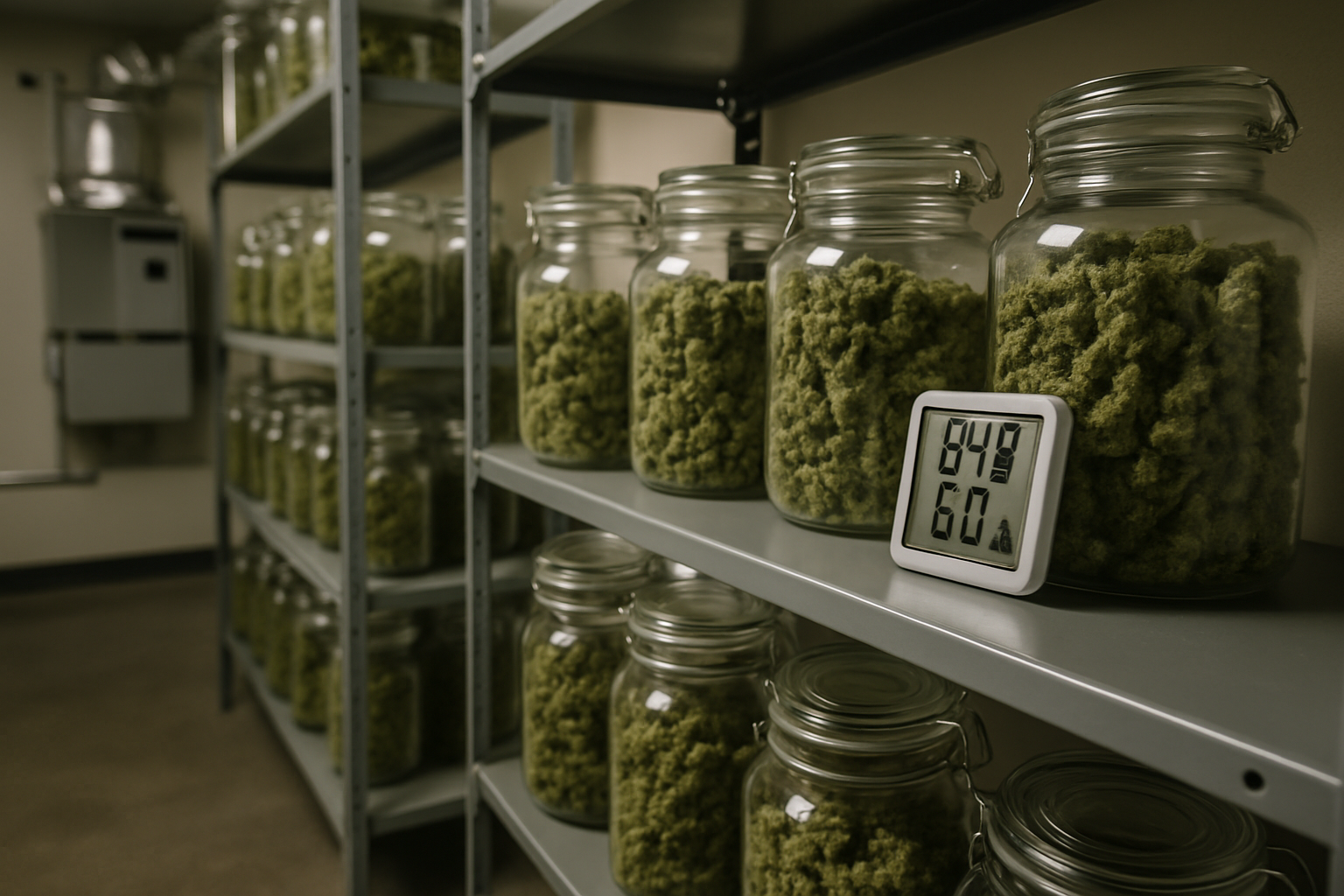
Cannabis dispensaries: monitoring flower storage temperature and humidity to protect potency and pass inspections
Cannabis storage temperature and humidity monitoring: a compliance and product-quality guide
Cannabis is one of the most environmentally sensitive products a regulated business can hold. Store it too warm or too humid and you invite mold. Let the air get too dry and you lose terpenes, aroma, and literal weight off the scale. And because cannabis is a controlled, high-value product under state oversight, the conditions it sits in aren't just a quality concern—they're a compliance one.
This guide covers both sides: keeping flower, edibles, and concentrates inside the ranges that protect their value, and keeping the records that prove you did it. We'll walk through concrete storage targets, what state programs and track-and-trace systems expect from your documentation, how continuous wireless monitoring differs from manual logs and standalone thermometers, the real-world failure scenarios that monitoring catches, and what to look for when you buy a system.
Why storage environment makes or breaks cannabis quality and compliance
Two things are on the line every hour your product sits in storage. The first is passing inspection. The second is protecting potency, weight, and shelf life. These stakes are linked—the same conditions that preserve a product's quality are the conditions an inspector expects you to document and maintain.
The problem is that the threats are quiet. A mold outbreak in a curing room doesn't announce itself; it starts with relative humidity creeping a few points too high for a few days. Terpene loss from over-dry air happens gradually, batch after batch, until customers notice the aroma isn't what it was. And an after-hours compressor failure in a vault cooler can run for twelve hours before anyone walks in the next morning to find product ruined.
Temperature and humidity drift slowly and compound before anyone notices. By the time a staff member spots a problem on a manual round, the damage—and the gap in your records—is already done. The rest of this article lays out the targets to aim for, the records to keep, why monitoring beats manual checks, the failures it catches, and how to choose and place a system.
Target temperature and humidity ranges for storing cannabis
The general goal for storing cannabis is cool, stable temperatures paired with controlled relative humidity. Cannabinoids and terpenes degrade faster when they're warm, exposed to light, or subjected to swinging conditions, so consistency is as important as the numbers themselves.
Flower and curing. The widely cited target for cured flower is roughly 55–62% relative humidity. Stay inside that band and the flower holds its moisture, structure, and terpene profile. Drift above it and you risk mold; drift below and the product dries out and gets harsh. Temperatures in the low-to-mid 60s°F are a common storage reference, kept stable rather than cycling.
Edibles and concentrates. These products have different needs. Many edibles and concentrates do best in cooler storage, and moisture is often the enemy—condensation can degrade texture, packaging, and shelf life. Some concentrates are kept cold or even frozen depending on type. The common thread is avoiding heat and unwanted moisture.
Stability matters as much as the numbers. A product held steadily at the edge of its range is usually better off than one bouncing through the middle of it. Swings cause condensation when warm, humid air meets a cold surface, and they stress the product. A cooler that cycles hard between setpoints can do more harm than one that runs a touch warm but holds steady.
Exact ranges vary by product type, packaging, and the state you operate in. Treat these as starting points and verify your targets against your own regulations and your supplier or lab guidance.
Why humidity matters as much as temperature
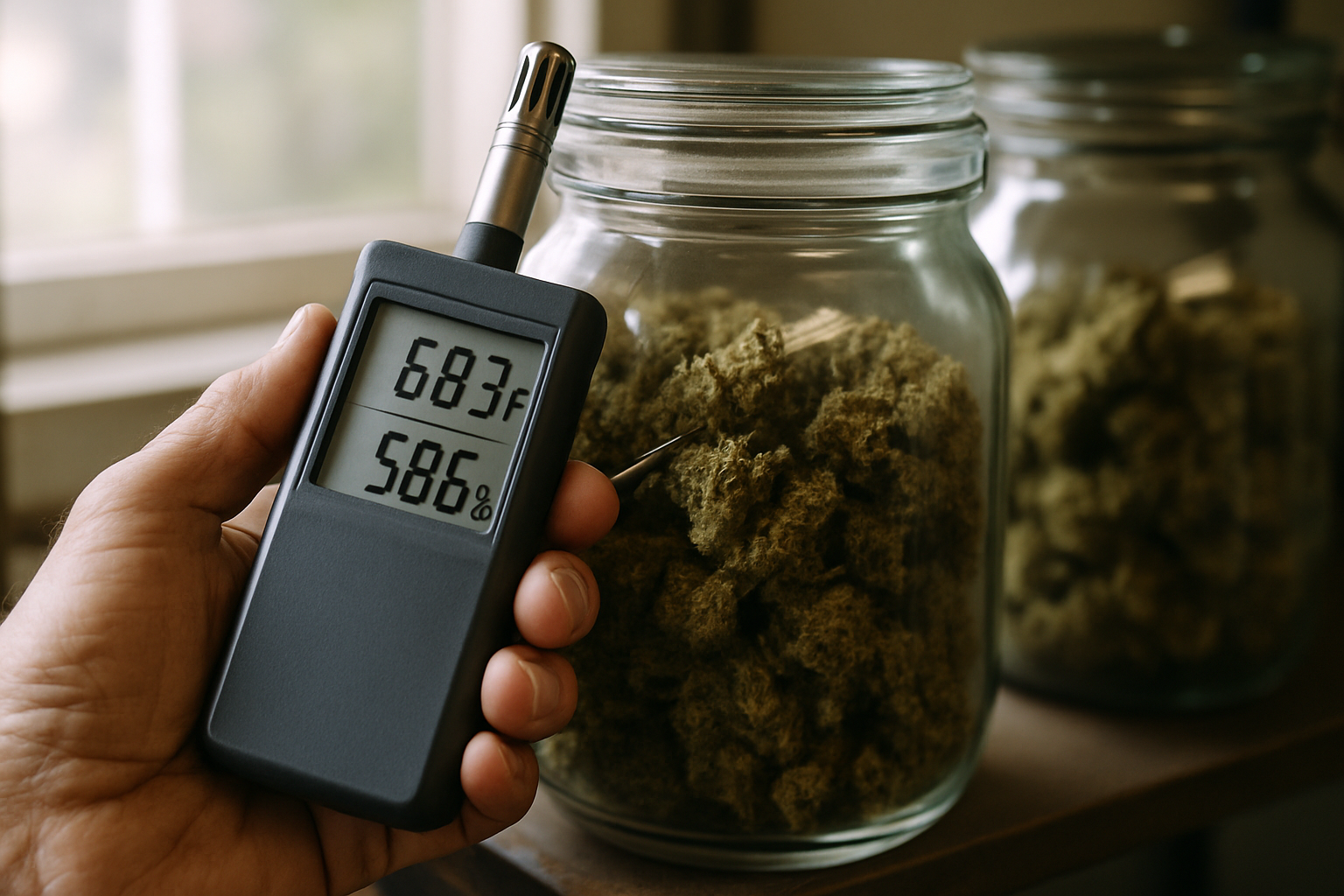
Most operators instinctively watch temperature and treat humidity as secondary. For cannabis, that's a mistake—humidity drives some of the most expensive failures you can have.
High RH invites mold and microbial growth. When relative humidity climbs too high, flower becomes a breeding ground for mold and microbes. That can fail required lab testing and force the destruction of an entire batch. One humidity excursion in a curing room can wipe out product worth far more than any monitoring system costs.
Low RH dries out flower and strips terpenes. Air that's too dry pulls moisture out of the flower, degrades the volatile terpenes that carry aroma and flavor, and leaves a product that smokes harsh and smells flat. Perceived quality drops, and so does what customers will pay.
Moisture content ties directly to weight. Cannabis is often sold by weight, and water weight is part of that. Over-drying doesn't just hurt quality—it shrinks your sellable product. A few percentage points of lost moisture across a large inventory is a direct financial hit.
Temperature and humidity interact. They aren't independent. A cooler failure can spike both at once—rising temperature changes how much moisture the air holds, and condensation follows. This is exactly why a plain thermometer misses half the picture. Monitoring both at the same point, at the same time, is the only way to understand what the product is actually experiencing. This is the same reason we stress dual sensing for dry storage rooms, where humidity is the variable most operations forget to watch.
What state regulations and track-and-trace expect from storage records

Cannabis is one of the most heavily documented products in commerce, and storage conditions are part of that paper trail.
Many regulated programs expect documented, defensible storage-environment records—evidence that product was held under appropriate conditions over time, not just a one-time reading. The exact wording varies, but the expectation of maintained and provable conditions is common.
Track-and-trace systems like the state seed-to-sale platforms focus mainly on product movement: where each unit is, who handled it, and where it went. They don't usually capture environmental conditions directly. But storage records complement that chain. If a product is ever questioned, recalled, or tested, being able to show it was stored correctly supports your quality claims and your recall defense.
Inspectors may ask to see logs demonstrating that conditions were maintained across days, weeks, and months—not just the moment they walked in. This is where manual logs fall apart. Gaps, missed weekend entries, and suspiciously tidy handwriting are common audit weaknesses, and a logbook with holes in it is hard to defend.
Specific recordkeeping formats and retention periods differ by state agency. Confirm what your state requires, then make sure your system can produce it.
Continuous wireless monitoring vs. manual logging and standalone thermometers
Once you accept that conditions need to be both maintained and proven, the limits of older methods become clear.
Manual logs capture a single moment. A staff member reading a gauge twice a day records two data points and misses everything in between—including the overnight and weekend drift when no one is on site. That's precisely when compressors fail and doors get left open.
Standalone dataloggers record but don't alert. A datalogger quietly captures readings, which is better than nothing, but you only learn about a problem when you download the data later. By then the product may already be lost. We cover this tradeoff in detail in our comparison of data loggers versus real-time monitoring.
Continuous wireless monitoring does both. It takes readings on a set interval—for example every 20 minutes—and stores them automatically in a time-stamped history. No one has to remember to write anything down, which removes the human error and gaps that undermine manual logs. The result is a complete, continuous record you can hand to an inspector.
The deciding difference is alerting. A monitoring system tells you the moment a reading goes out of range, by text, email, or app, so you can act before product is ruined—not discover it the next morning.
Catching equipment failures and personnel issues before product is lost
The value of real-time monitoring shows up in specific, recurring scenarios.
After-hours compressor failure. A vault cooler's compressor dies at 2 a.m. on a Saturday. Without monitoring, you find out Monday when you open the door to warm, humid, mold-prone product. With alerting, you get a notification immediately and can move inventory or call for service before anything is lost.
Doors left open during stocking. A vault or cooler door propped open too long while staff restock lets temperature and humidity climb. Monitoring not only catches the excursion but reveals the pattern—repeated spikes at the same time of day point to a workflow problem you can fix with training, not just a one-off. This kind of insight into staff habits is one of the quieter benefits of continuous data.
A failing cooler before it fully dies. Equipment rarely quits all at once. Watching for gradual temperature creep—a unit that used to hold its setpoint now running a degree or two warmer each week—lets you schedule service before an emergency failure.
Humidity spikes in drying and curing rooms. A dehumidifier or HVAC problem shows up as rising RH long before mold appears. Catching it early protects the whole batch.
Timely alerts protect both your compliance record and your inventory value at the same time.
Reading frequency and record retention
How often you record matters as much as whether you record at all.
Frequent interval readings—every 20 minutes, for instance—capture the full shape of what your product experiences. Once- or twice-daily manual checks can completely miss an overnight excursion that resolved itself by morning, leaving you with product that was compromised and a record that says everything was fine.
Continuous data also builds the trend history you need to prove conditions were maintained and to diagnose issues. A dense record lets you see exactly when a problem started, how long it lasted, and whether it's recurring.
For retention, keep records long enough to cover your audit cycles and any recall windows that apply to your products. Retention requirements vary by state, so verify the specific period your agency requires and set your system to hold data at least that long. Exportable records—clean reports you can hand over or review internally—make inspections and quality reviews far less stressful than paging through a binder.
What to look for in a cannabis monitoring system
Not all monitoring tools are equal. A few criteria separate systems that actually protect product from ones that just log numbers.
- Real-time alerting. The system should notify you by text, email, or app the moment a reading goes out of range. This is the single most important feature for preventing loss.
- Long, user-replaceable battery life. Batteries that last years—and that you can swap yourself—prevent monitoring gaps and avoid the cost of replacing whole sensors. A battery rated for roughly a decade means you're not chasing dead devices.
- Wireless install with no drilling. For vaults, coolers, and leased spaces, a wireless system that needs no holes drilled is a major advantage. It protects deposits and lets you move or add sensors freely.
- Both temperature and humidity in one device. Since both matter for cannabis, a single sensor measuring both at the same point gives you the complete picture.
- Placement flexibility and multi-zone coverage. You'll have several independent areas to watch, so the system should scale across zones without a tangle of wiring.
- Reliable data storage and easy export. Compliance depends on producing clean, time-stamped reports on demand.
If you're weighing connectivity options, our look at WiFi alarms versus cellular monitoring explains why a system that keeps alerting even when the internet drops is worth prioritizing.
Setting up monitoring across your facility
A cannabis operation has several distinct environments, each with its own targets and risks.
Grow rooms. Track ambient temperature and humidity swings that affect plant health and set the stage for mold. These rooms change fast with lighting cycles and irrigation.
Drying and curing areas. This is where RH control is most critical. Keep humidity inside your target band and watch for dehumidifier failures that let it climb.
Vaults and storage coolers. Monitor for compressor failure and door-left-open events. These spaces often hold the most valuable, finished inventory, so they deserve the tightest alerting. Many of the same placement principles from our guide to sensor placement in walk-in coolers apply directly here.
Retail display cases. Product on the sales floor still degrades under heat, light, and dry air. Monitoring protects quality right up to the point of sale.
Placement tips. Position sensors at the height where product actually sits, away from direct airflow from vents and away from heat sources like lights or compressors that would give false readings. Cover each independent cooling zone with its own sensor—one device can't speak for a cooler it isn't inside.
Set thresholds per zone. A curing room and a concentrate freezer need very different alert limits. Configure each zone's thresholds based on the product stored there so alerts are meaningful and you're not drowning in false alarms.
What is the ideal humidity range for storing cannabis flower?
Cured cannabis flower is commonly stored in the range of about 55–62% relative humidity. Staying inside that band preserves moisture, structure, and terpenes while keeping humidity low enough to discourage mold. Your exact target may vary by product and packaging, so confirm against your own standards and state rules.
Do state cannabis regulations require temperature and humidity records?
Many regulated programs expect documented, defensible storage-environment records, though the specific requirements vary by state. Even where environmental logging isn't spelled out explicitly, maintained condition records support quality claims, recall defense, and inspections. Check with your state agency for the exact recordkeeping and retention rules that apply to your license type.
How often should cannabis storage conditions be recorded?
Frequent interval readings give a far more accurate picture than once- or twice-daily manual checks. A system that records automatically every 20 minutes captures overnight and weekend drift that manual rounds miss, and it builds the continuous trend history you need to prove conditions were maintained and to diagnose problems.
Can a wireless monitor alert me if a cooler or vault door is left open?
Yes. When a door is left open, temperature and humidity inside begin to climb, and a monitoring system with real-time alerting will notify you once readings cross your thresholds. Over time, the data also reveals patterns—repeated spikes during stocking point to a staff workflow issue you can correct.
How long do monitoring batteries last and are they replaceable?
Look for sensors with long battery life—a battery rated for around 10 years means you won't face frequent replacements or monitoring gaps. Equally important is whether the battery is user-replaceable, so you can swap it yourself instead of discarding the whole device when it eventually runs down.
Have Questions About VitaTemp?
Our team is here to help you with temperature monitoring solutions for your business.